Pipeline
Our DARPin therapeutics offer unique solutions
to challenges not readily addressable by other modalities
MP0712/212Pb x DLL3 Radio-DARPin Therapy: SCLC and neuroendocrine tumors
MP0712 is a radiopharmaceutical directed specifically against DLL3 (delta-like ligand 3), a validated target expressed in more than 85% of patients with small cell lung cancer (SCLC).
Despite recent advances in the treatment of SCLC, there is still a high unmet need for patients not responding or relapsing from bispecific T-cell engagers or antibody-drug conjugates (ADC).
MP0712 delivers the potent alpha-emitting therapeutic isotope 212Pb in a targeted manner to DLL3-expressing tumor cells, thereby killing tumor lesions and minimizing impact on healthy tissues. This powerful mode of action offers the potential to significantly improve treatment options for these patients.
MP0712 is being co-developed by Molecular Partners and our strategic partner Orano Med, a pioneer in targeted alpha therapy.
MP0726/212Pb x MSLN Radio-DARPin Therapy: Ovarian cancer
MP0726 is a radiopharmaceutical delivering the potent alpha-emitting therapeutic isotope 212Pb to mesothelin (MSLN) expressing tumors. MSLN is a tumor target highly expressed in patients with ovarian cancer (>80% prevalence), and its expression is maintained in metastases. Molecular Partners has designed DARPins which selectively bind to a MSLN part proximal to the target cell membrane to avoid impact from high shedding, a potential challenge for the development of therapeutics against MSLN.
MP0726 is being co-developed by Molecular Partners and our strategic partner Orano Med, a pioneer in targeted alpha therapy.
Radio-DARPin Therapy: Solid Tumors
The strategic collaboration between Molecular Partners and Orano Med covers the development of up to 10 targeted alpha therapeutics: The strategic collaboration between Molecular Partners and Orano Med covers the development of up to 10 targeted alpha therapeutics, with 212Pb as radioactive payload. The first two of these Radio-DARPin therapeutics have been selected (MP0712 / 212Pb x DLL3 Radio-DARPin and MP0726 / 212Pb x MSLN Radio-DARPin).
Radio-DARPin Therapy (RDT)
MP0533 / CD33 x CD123 x CD70 x CD3: r/r AML and AML/MDS
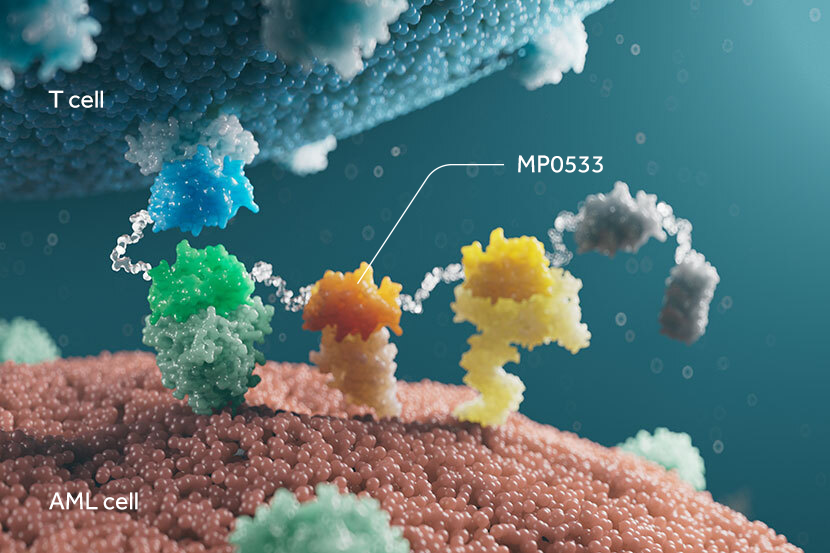
MP0533 is a novel tetra-specific T cell engager designed to kill all acute myeloid leukemia (AML) cells – blasts and also leukemic stem cells known to drive relapse – while minimizing damage to healthy cells. MP0533 targets three antigens preferentially co-expressed on AML cells. The strength of binding to cells increases with the number of targets engaged, thereby strongly favoring binding to AML cells over healthy cells.
Mechanism of Action
CD3 Switch-DARPin: Next-Gen T Cell Engagers
Our Switch-DARPins enable the design of next-generation immune cell engagers with increased safety and potency by providing a logic-gated “on/off” function (the “Switch”) to multi-specific DARPin molecules. This allows targeted, conditional immune activation only in the presence of defined targets. We have shown the feasibility of conditional T cell activation with potent co-stimulation in solid tumors while sparing healthy tissues.
MP0621 / cKIT x CD16a x CD47 Switch-DARPin
MP0621 is a Switch-DARPin candidate designed to induce killing of hematopoietic stem cells (HSCs) as a next-generation conditioning regimen for HSC transplantation.
MP0621 is an immune cell engager which combines targeting of cKit with conditional blockade of CD47. cKit is a highly attractive target to eliminate HSCs as it is critical for stem cell maintenance and renewal. The CD16a DARPin enables engaging NK cells and macrophages to selectively kill HSCs. Conditional blocking of the “do-not-eat-me” signal (CD47) only on HSCs via a Switch-DARPin allows leveraging the power of CD47 inhibition without its associated toxicity.
MP0317 / FAP x CD40: Advanced Solid Tumors
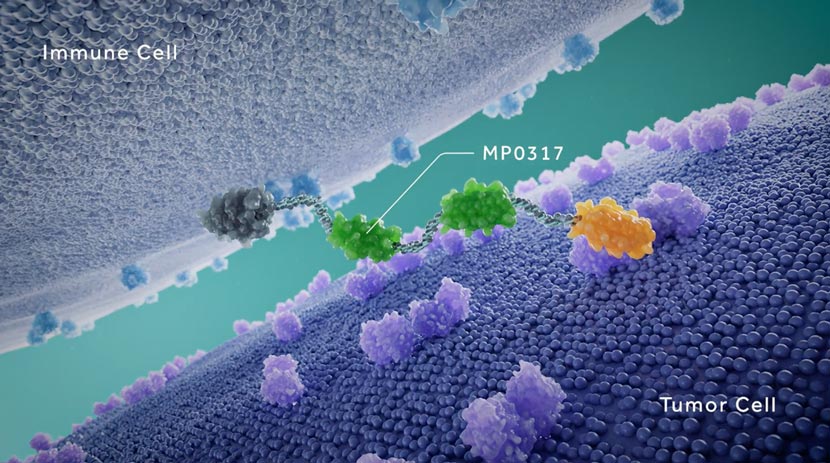
MP0317 is a tumor-localized CD40 agonist designed to activate immune cells specifically within the tumor microenvironment by anchoring to fibroblast activation protein (FAP) which is found at high density in the tumor stroma. This tumor-localized mechanism of action aims to achieve greater activity with fewer side effects compared to systemic CD40-targeting therapies.
Mechanism of Action
Next-Gen Immune Engagers
Ensovibep / Sars-Cov-2: COVID
Ensovibep is a COVID-19 antiviral therapeutic candidate designed specifically to inactivate SARS-CoV-2 – the virus that causes COVID-19 – with extremely high potency that is preserved against novel variants. In January 2022, we announced positive topline results from our Phase 2 global clinical study of ensovibep in acute COVID-19 ambulatory patients showing approximately 80 percent reduction of the of combined risk of hospitalization, emergency room visits, or death compared to placebo, regardless of vaccination status. It was shown to be safe and well-tolerated. Comprehensive in vitro studies of ensovibep demonstrate its high inhibitory potency against all COVID-19 variants of concern, including Omicron, as of December 2021. Novartis has informed Molecular Partners of its intent to in-license ensovibep and is expected to lead late-stage development and commercialization.
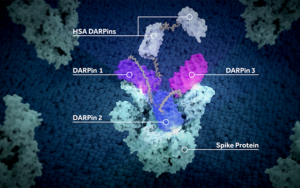
Ensovibep offers a differentiated approach to treating COVID-19 through a single molecule that can target up to three parts of the SARS-CoV-2 virus simultaneously to neutralize the virus through cooperative binding. This offers potentially broader efficacy and reduced potential for the development of viral drug resistance. All DARPins are produced through a rapid, high-yield microbial fermentation process.
Mechanism of Action
Need
COVID-19 represents the biggest disease burden in the world today through its impact on healthcare, society and economies. A multi-solution strategy is needed to combat the pandemic and the need for antiviral treatments to complement global vaccination efforts has never been greater. As disease transmission continues through pockets of unvaccinated populations, in patients with compromised immune systems and co-morbidities, and as variants continue to emerge, millions of patients around the world are in need of differentiated therapies that are specifically designed to combat COVID-19 in all its forms.
Rationale
The DARPin platform is designed to be used to rapidly generate diverse, multifunctional drug candidates, capable of binding to multiple targets at once. As a tri-specific candidate with cooperative binding, ensovibep’s unique pan-variant design has allowed it to retain full potency against all known variants of concern including the Omicron variant in comprehensive preclinical studies conducted to-date.
Solution
Ensovibep is a unique tri-specific candidate designed to preserve potency against viral variance. It exhibits among the most potent viral inhibition against all variants of concern reported to date. In the EMPATHY Phase 2 global clinical trial, ensovibep demonstrated approximately an 80 percent reduction of combined risk of hospitalization, emergency room visits or death in non-hospitalized patients compared to placebo regardless of vaccination status. It was shown to be safe and well-tolerated. If approved or authorized, ensovibep will be the first multi-specific antiviral molecule for the treatment of COVID-19.
Mechanism of Action
*The co-development agreement with Orano Med includes ten programs, including MP0712 (DLL3) and MP0726 (MSLN).